10 Key Business Process Automation Trends Shaping 2026
Companies across industries are transforming their operations through advanced automation technologies that eliminate bottlenecks and accelerate growth. Business process automation trends in 2026 focus on AI-powered workflows, intelligent document processing, and hyperautomation strategies that reduce costs while improving accuracy. These innovations allow organizations to scale operations without expanding headcount, creating competitive advantages that compound over time.
Understanding which automation technologies align with specific business needs requires careful evaluation of countless tools and platforms. Rather than spending weeks researching robotic process automation solutions, low-code platforms, and integration options, businesses can leverage Bud's AI agent to quickly identify the most relevant trends and receive actionable recommendations tailored to their unique workflow challenges.
Table of Contents
-
Why Enterprises Are Rethinking Automation at Scale
-
Top 10 Business Process Automation Trends in 2026
-
What This Means for Enterprise Leaders
-
How to Stay Ahead in BPA Adoption
-
Streamline Your Enterprise BPA with Bud's AI Agent
Summary
-
Enterprise automation spending increased by 73% in 2024, with nearly 40% of companies reporting at least a 25% cost reduction, according to the Enterprise Automation Index 2025. That investment reflects a shift from isolated automation wins to enterprise-wide transformation. The real barrier isn't technology adoption but building systems that remain reliable when workflows change, exceptions multiply, and regulatory requirements shift without warning.
-
The U.S. hyperautomation market reached $14.14 billion in 2024 and is projected to hit $69.64 billion by 2034, reflecting a compound annual growth rate of 17.28%. This growth signals that enterprises are betting on automation that scales across departments rather than on single-function improvements. The value comes from integration, where RPA handles execution, AI analyzes patterns, and process mining identifies bottlenecks, creating systems that optimize themselves rather than requiring constant manual adjustment.
-
AI adoption in enterprises surged from 55% in 2023 to 72% in 2024, according to McKinsey research. This acceleration reflects how organizations have realized that traditional automation hits a wall when exceptions arise. Machine learning algorithms enable automation to improve over time rather than degrade as conditions change, handling complexity that rigid scripts cannot handle. The global business process automation market reached $13.7 billion in 2023 and is expected to reach $41.8 billion by 2033, driven by AI, which is making automation viable for processes that require judgment and adaptation.
-
Process mining tools create detailed workflow maps that reveal the gap between how processes should work and how they actually work. Over 77% of enterprise leaders identify process transparency as the top value from process mining, according to industry research. The global process mining market is expected to reach $12.1 billion by 2028, growing at a 45.6% annual rate. Understanding actual workflow across systems becomes the foundation for intelligent automation because you cannot optimize what you cannot see.
-
Low-code and no-code platforms compress development time by 50 to 90% compared to traditional coding, enabling business users to build automation without developer involvement. This removes the technical barrier between identifying an automation opportunity and deploying a solution. Cloud-based LCNC applications reduce upfront IT infrastructure investment while providing on-demand scalability, accelerating innovation by eliminating the gap between need and implementation.
-
Bud's AI agent addresses this by operating within complete computing environments rather than as isolated scripts, adapting to interface changes and maintaining workflow continuity across web, text, and messaging channels without breaking when upstream systems update.
Why Enterprises Are Rethinking Automation at Scale
Business process automation isn't new. Most companies already run automation programs, but the systems they built failed when unexpected situations arose, workflows changed, or user interface layers shifted without warning. RPA scripts that worked in January broke silently in March because a vendor updated their interface. The result was a fragile infrastructure requiring constant maintenance.

Key Point: Traditional automation systems fail when they encounter unexpected changes, creating maintenance nightmares for IT teams.

Warning: RPA scripts that work today may break tomorrow without warning when vendors update their systems, leaving businesses scrambling to fix critical workflows.
What forces are driving the automation transformation?
Two forces converged in 2026, reshaping how executives approach automation. First, the robotic process automation market is expected to reach USD 23.94 billion by 2029, more than tripling from 2024 levels. Boards now demand repeatable ROI across departments rather than isolated wins in finance, while operations remain dependent on spreadsheets.
Second, autonomy arrived faster than governance. Task-specific AI agents will appear in 40% of enterprise applications this year, up from less than 5% in 2025. Most organizations lack the orchestration patterns, exception handling, and audit frameworks to manage this safely. Our Bud platform helps enterprises implement these critical governance and orchestration capabilities as AI agents scale across their operations.
The cost of doing nothing
According to the Enterprise Automation Index 2025 by Redwood Software, 73% of companies increased automation spending, and nearly 40% report at least 25% cost reduction. Without automation, competitors reduce cycle times while your team waits three days for approvals. Repetitive tasks consume hours better spent on strategic work, human error creates cascading costs, and manual processes cannot scale during demand spikes or hiring freezes.
What does credible automation include in 2026?
A credible automation strategy in 2026 includes automation within orchestration patterns that route work intelligently, exception and escalation design that handles unusual cases without breaking, identity and permissioning that scales across teams, audit evidence that meets compliance needs, and measurable performance management that demonstrates value over time.
Hyperautomation is a disciplined mix of RPA and AI with policy controls that hold up through change. It builds systems that adapt when conditions shift, new rules arrive, or vendors change their APIs without notice.
How do modern platforms handle automation flexibility?
Platforms like Bud exemplify this shift toward agents operating within complete computing environments. Rather than fragile scripts that break when interfaces change, autonomous agents with full system access can adapt to UI shifts, handle exceptions, and maintain workflow continuity across web, text, and messaging channels.
That flexibility matters when downtime costs extend beyond lost hours to stalled decisions across departments.
What prevents enterprise-wide automation success?
Most organizations struggle to move from isolated automation wins to enterprise-wide transformation. The patterns that deliver sustained ROI aren't obvious, and the gap between adopting AI agents and governing them responsibly continues to widen.
Top 10 Business Process Automation Trends in 2026
The automation landscape in 2026 will involve significant changes in how systems think, adapt, and operate without constant human oversight. Ten trends are reshaping how businesses approach process automation, each addressing problems that traditional automation couldn't solve. Key Point: The 2026 automation transformation isn't just about faster processes—it's about intelligent systems that can adapt, learn, and make decisions without human intervention.

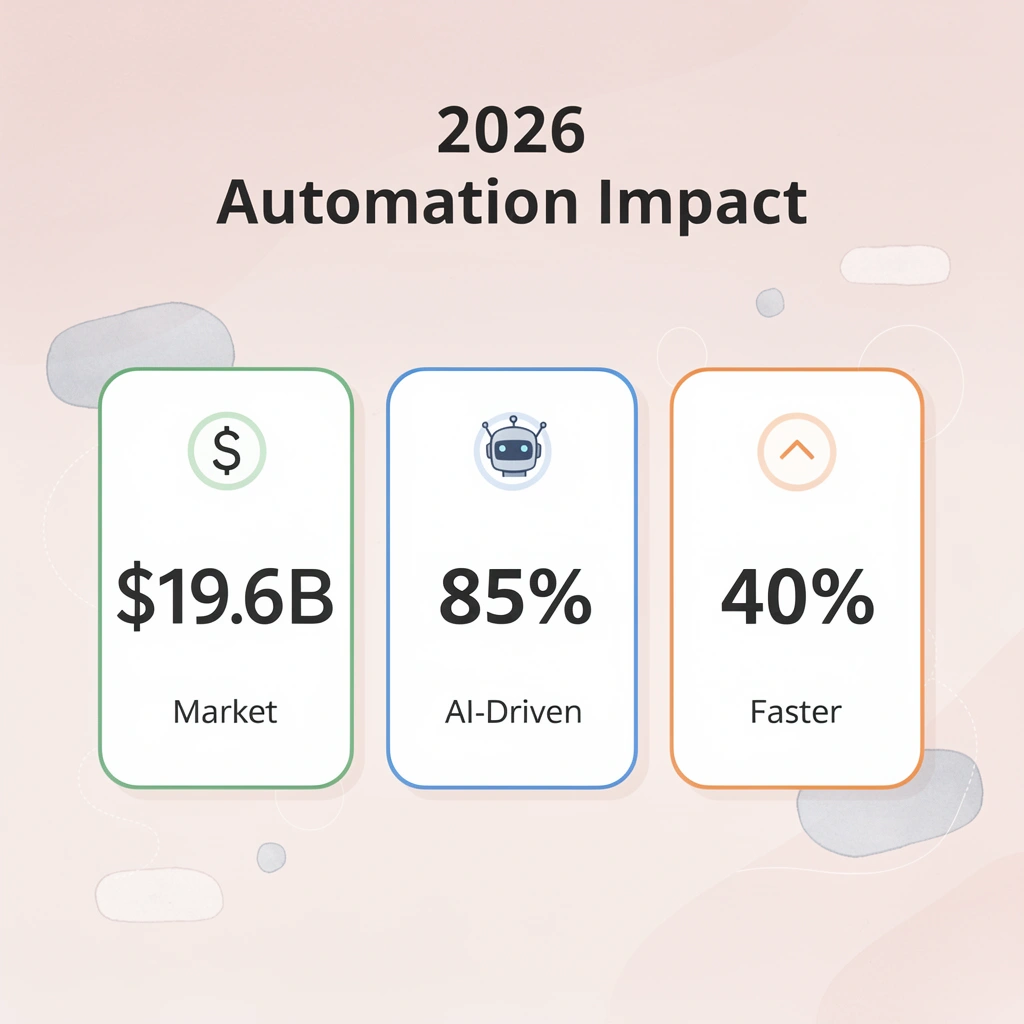
Tip: Organizations that embrace these ten automation trends early will gain a competitive advantage of up to 40% faster process execution and 60% reduced operational costs compared to those using legacy automation approaches.
1. Hyperautomation Takes Center Stage
Hyperautomation combines AI, RPA, and process mining to handle entire workflows without human intervention. The U.S. hyperautomation market was valued at $14.14 billion in 2024 and is projected to reach $69.64 billion by 2034, reflecting a compound annual growth rate of 17.28%. This growth indicates companies are prioritizing cross-departmental automation over isolated functional improvements.
When RPA handles execution, AI analyzes patterns, and process mining identifies bottlenecks, you get self-optimizing systems. An insurance company struggling with slow claim processing can deploy AI to scan customer data across all systems, pinpoint delays, and accelerate approvals without manual review. The result is faster claims plus predictive insight into where future delays will emerge.
How does hyperautomation enable organizational modeling?
Gartner research describes how hyperautomation enables the Digital Twin of the Organization: a virtual model showing how KPIs interact in real time. This surfaces opportunities for operational change, and estimates the impact on costs and productivity before implementation. When you can model how a process change affects downstream workflows and predict ROI within a margin of error, decision-making shifts from intuition to evidence.
Key Benefits
-
Security and compliance at scale: Hyperautomation identifies AI-powered malware and social-engineering attacks that traditional systems miss.
-
Process mining for bottleneck elimination: Examining how processes connect reveals where work stalls and what changes will reduce cycle times.
-
Hyper-personalization: Customer data feeds systems that customize experiences in real time, improving satisfaction and conversion without manual segmentation.
-
End-to-end orchestration: Process maps identify automation opportunities across entire workflows, enabling smooth execution from trigger to completion.
2. Integration of AI and Machine Learning
AI and machine learning enable automation to handle complexity that scripts cannot. They analyze large datasets, identify patterns, and make real-time decisions, separating smart automation from rigid task execution. According to McKinsey, AI adoption jumped from 55% in 2023 to 72% in 2024, reflecting how quickly organizations discovered that traditional automation reaches its limits when exceptions arise.
Machine learning algorithms improve over time as conditions change. In customer service, AI chatbots filter routine questions, escalate complex issues to people, and learn which questions require escalation based on sentiment analysis and context.
How does AI automation impact real business operations?
In supply chain logistics, machine learning predicts demand changes and adjusts inventory allocation to prevent stockouts. AT&T used RPA robots to automate invoice creation and payment processing, but the real value emerged when AI identified patterns in payment delays and recommended process changes that reduced outstanding receivables.
The global business process automation market reached $13.7 billion in 2023 and is expected to hit $41.8 billion by 2033. This growth is driven by AI, which enables the automation of processes requiring judgment, adaptation, and predictive insight, not merely accelerating existing tasks.
Key Benefits
-
Automation of complex processes: AI handles data extraction, resource allocation, and decision-making that previously required human oversight.
-
Predictive analytics: Systems predict customer behavior, market trends, and operational issues before they occur.
-
Process optimization: AI identifies inefficiencies and recommends improvements based on historical performance data.
-
Incident management: Machine learning detects unusual activity and security threats in real time by analyzing logs, network traffic, and system metrics.
-
Customer support scalability: Chatbots answer common questions instantly while routing complex cases to specialists, maintaining quality without expanding staff.
3. Low-Code and No-Code Automation Platforms
Low-code platforms require basic coding skills and allow developers to customize applications through visual interfaces combined with traditional code. No-code platforms eliminate coding entirely, enabling non-technical users to build applications via drag-and-drop interfaces. Both accelerate development cycles and reduce dependence on IT resources.
SnF Management Company operated skilled nursing and rehabilitation centers under the Windsor name in California. Their CapEx approval workflows relied on email-based paper processes that took weeks or months to complete. After adopting Cflow, a no-code AI-powered automation platform, they reduced approval cycles from months to days, enabling capital investments to arrive when needed rather than after opportunities had passed.
Key Benefits
-
Faster development: LCNC platforms reduce development time by 50-90% compared to traditional coding, enabling teams to respond quickly to changing business needs.
-
Cost savings: Business users can handle tasks without developers, cutting operational costs and freeing technical teams for important projects.
-
Increased automation: Workflows and decision-making happen automatically without writing code, improving efficiency across all departments.
-
Lower IT infrastructure needs: Cloud-based LCNC applications reduce upfront costs and enable flexible scaling.
-
Improved customer experience: Applications update quickly based on customer feedback, keeping services responsive and useful.
-
Efficient governance: Streamlined governance and compliance tools enable IT teams to manage applications while maintaining control.
-
Increased agility: LCNC tools help businesses adapt quickly to changing demands with minimal risk.
4. Robotic Process Automation (RPA)
RPA uses software robots to automate tasks that humans typically perform through application interfaces. These bots record user actions and interactions, then repeat them at scale. Repetitive tasks like data migrations and approval workflows, high-volume tasks like customer service interactions, and multi-system tasks requiring access across different applications are all automated without changing the underlying systems.
According to Rebbix, 87% of companies are expected to adopt AI-powered automation tools by 2026. RPA has evolved from simple task automation to intelligent execution when combined with AI and machine learning. While RPA performs tasks, AI and ML add thinking and learning capabilities, training algorithms to use data so that the software performs tasks faster and more efficiently over time.
Thermo Fisher Scientific, the biotechnology company headquartered in Waltham, Massachusetts, automated 53% of invoices using RPA, reducing data extraction and invoice processing time by 70%. This freed finance teams to focus on strategic analysis instead of manual data entry, shifting their role from processing to insight.
Key Benefits
-
Minimal coding: Easy-to-use drag-and-drop tools let users set up automation without developers.
-
Quick cost savings: Automating tasks frees up resources for more important work, increasing productivity and returns on investment.
-
Improved customer satisfaction: Bots work 24/7, reducing wait times and increasing customer satisfaction.
-
Enhanced employee morale: Automating repetitive tasks enables employees to focus on strategic and rewarding work.
-
Greater accuracy and compliance: Set workflows ensure consistency, reduce errors, and maintain regulatory compliance.
-
Smooth integration: RPA works with your existing applications without disrupting systems or requiring complicated integrations.
5. Process Mining
Process mining analyzes how work flows through systems by examining event logs and data trails, revealing the gap between intended and actual processes. Process mining tools like Celonis create detailed workflow maps, identify bottlenecks, and measure the impact of changes before implementation.
The global process mining market is expected to reach $12.1 billion by 2028, growing at a compound annual growth rate of 45.6%. Over 77% of enterprise leaders identify process transparency as the top value from process mining tools. Understanding the actual flow of work across systems forms the foundation for intelligent automation.
PepsiCo struggled to prioritize collections, as many large organizations do. Using Celonis, they discovered that improving Days Sales Outstanding (DSO) would deliver considerable value. Process mining identified specific actions to accelerate customer payments through process improvement rather than policy changes, enabling faster cash flow without damaging customer relationships.
Key Benefits
-
Process transparency: You can see how work flows through your organization, helping identify problems hidden in complicated systems.
-
Process transformation: Information from data helps you automate work by identifying what can be improved before you make changes.
-
Reducing throughput time: Better processes help work move faster from start to finish by removing bottlenecks and optimizing resource use.
-
Cost savings: Automating repetitive, time-consuming tasks prone to error delivers measurable financial benefits.
-
Improved customer experience: Faster responses and focused improvements deliver better service, increasing customer satisfaction and loyalty.
6. AI-Powered Chatbots
AI-powered chatbots using large language models can understand context, interpret images, and generate human-like responses. They summarize documents, generate reports, and handle multilingual conversations without human intervention. This shift from scripted responses to contextual understanding transforms what contextual understanding can accomplish at scale.
How do autonomous agents handle complex tasks?
Platforms like Bud extend this capability beyond customer-facing interactions. AI agents operate within complete computing environments, handling tasks that require navigating multiple systems, adapting to interface changes, and maintaining context across channels. This flexibility proves essential when customer inquiries demand pulling data from CRM systems, checking inventory databases, and generating personalized recommendations in real time.
What value do chatbots provide for support teams?
The value lies in filtering volume so specialists handle complex cases while chatbots resolve routine inquiries instantly. This compression reduces wait times, improves customer satisfaction, and allows support teams to focus on problems requiring judgment and empathy.
Key Benefits
-
24/7 availability: Round-the-clock support without additional staffing costs. This reduces wait times and improves customer satisfaction.
-
Multi-language capability: Answer questions in different languages without hiring multilingual staff.
-
Context retention: Remembering what was discussed in past conversations so each new conversation feels smooth and connected.
-
Document processing: Summarizing written material, creating reports, and extracting important information from messy data without manual effort.
7. Cloud and Mobility
Cloud-native platforms bring together tools and technologies into workflows accessible from anywhere. Gartner predicts that investment in public cloud will reach $679 billion in 2026 and exceed $1 trillion by 2027. This reflects how companies have learned that teamwork depends on data accessibility: when team members cannot access systems from phones or tablets, decisions slow down, and workflows break down.
Mobility advances when teams work across different time zones and locations. Statista reports that 72% of workers use mobile devices for work tasks. This drives demand for automation tools optimized for mobile phones, enabling managers to monitor workflows, approve requests, and track project milestones without returning to a desktop.
How do cloud-based platforms accelerate innovation?
Cloud-based LCNC applications reduce upfront IT infrastructure investment while providing on-demand scalability, accelerating innovation by removing barriers between identifying automation opportunities and implementing solutions.
Key Benefits:
-
Smooth collaboration: Project members can access workflows from anywhere, keeping work moving smoothly across distributed teams.
-
Reduced infrastructure costs: Cloud-based platforms eliminate high upfront costs while allowing the system to scale as needed.
-
Real-time monitoring: Mobile access lets managers track workflows and fix problems immediately, wherever they are.
-
Faster deployment: Cloud platforms reduce the time from identifying automation needs to implementing solutions.
8. Intelligent Document Processing (IDP):
That expansion reflects how critical unstructured data has become in modern workflows. Organizations generate massive volumes of documents daily, and manual processing creates delays, errors, and compliance risks. IDP eliminates those bottlenecks by automating data extraction and validation at scale.
In financial services, IDP processes loan applications by extracting key data points, validating them against internal systems, and triggering approval workflows. In healthcare, it digitizes patient records and insurance claims, accelerating processing while maintaining compliance. The shift isn’t just about speed—it’s about accuracy and the ability to handle complexity without human fatigue.
Key Benefits
-
Automated data extraction: AI captures and structures data from invoices, contracts, and forms without manual input.
-
Improved accuracy: Reduces human error in document handling and data entry.
-
Faster processing times: Documents move through workflows in minutes instead of days.
-
Regulatory compliance: Built-in validation ensures adherence to industry standards and policies.
-
Scalability: Handles increasing document volumes without additional staffing.
9. Digital Twins of Organizations (DTO)
Digital Twins of Organizations (DTO) create virtual replicas of business processes, systems, and workflows. These models simulate how operations perform under different conditions, allowing organizations to test changes before implementing them in the real world.
Instead of guessing how a process adjustment might impact operations, DTOs provide data-backed simulations. A manufacturing company can model supply chain disruptions and identify alternative sourcing strategies. A financial institution can simulate regulatory changes and evaluate compliance impacts before rollout.
The strategic advantage lies in foresight. DTOs reduce risk by enabling experimentation without real-world consequences. Organizations move from reactive decision-making to proactive optimization, where every major change is tested, measured, and refined in a virtual environment.
Key Benefits
-
Predictive decision-making: Simulate outcomes before implementing process changes.
-
Risk reduction: Identify potential failures without disrupting operations.
-
Operational visibility: Gain a comprehensive view of how systems interact.
-
Continuous optimization: Refine workflows based on real-time data and simulations.
-
Strategic planning: Align automation initiatives with measurable business outcomes.
10. Human-in-the-Loop (HITL) Automation
Despite rapid advances in AI, full autonomy isn’t always the goal. Human-in-the-loop (HITL) automation integrates human judgment into automated workflows where nuance, ethics, or complexity require oversight.
In HITL systems, automation handles routine tasks while humans intervene at critical decision points. For example, AI can flag potentially fraudulent transactions, but human analysts make the final determination. In content moderation, AI filters large volumes of data, but humans review edge cases to ensure accuracy and fairness.
This hybrid model balances efficiency with control. It ensures that automation scales operations without sacrificing accountability or quality. As AI systems grow more powerful, HITL becomes essential for maintaining trust, especially in high-stakes industries like finance, healthcare, and legal services.
Key Benefits
-
Improved accuracy: Human oversight reduces false positives and errors in critical processes.
-
Ethical decision-making: Ensures automation aligns with organizational values and regulations.
-
Flexibility: Humans handle exceptions that automated systems can’t resolve.
-
Quality assurance: Maintains high standards in complex workflows.
-
Trust and transparency: Builds confidence in automated systems among stakeholders.
These ten Business Process Automation Trends define how organizations move beyond task automation toward intelligent, adaptive systems. The shift isn’t just technological—it’s operational. Businesses that adopt these trends position themselves to operate faster, make better decisions, and scale without the constraints that limited previous generations of automation.
What This Means for Enterprise Leaders
Automation in 2026 shifts from a cost-reduction focus to a core design choice that transforms how organizations work, manage risk, and improve performance. The strategic question becomes not whether to automate, but how to build systems that remain reliable as workflows change, exceptions multiply, and regulatory requirements shift. Leaders who treat automation as infrastructure rather than isolated projects create competitive separation that compounds quarter over quarter. Key Point: The shift from cost-cutting automation to strategic infrastructure represents a fundamental change in how enterprises approach digital transformation and long-term competitive advantage.
Warning: Organizations still treating automation as isolated projects rather than integrated infrastructure will find themselves at a significant disadvantage as market conditions become increasingly dynamic and regulatory complexity continues to grow.
Why do end-to-end processes need explicit ownership?
Processes need someone in charge, metrics to measure performance, and clear steps for problem handling. Orchestration ensures process boundaries, handoffs, and dependencies are designed intentionally rather than left to chance.
When a customer order starts fulfillment, inventory updates, shipping notifications, and financial reconciliation must each handle incomplete upstream data or unavailable downstream systems. This discipline prevents invisible failures that cause work to stall without alerting anyone.
How does the control plane become a design priority?
The control plane becomes an important design problem as automation grows more powerful. Identities, permissions, logging, policy evaluation, and audit evidence must be decided at the start.
Treat automation like a privileged actor to reduce hidden risk, improve accountability, and prevent invisible execution where decisions occur without human oversight or forensic trails.
Why does AI automation require governance frameworks to succeed?
AI becomes powerful when connected to controlled execution. Decisions must be checkable, actions must be limited, and escalation must be intentional. This separates testing from production-grade AI-driven automation.
Most teams run pilots that demonstrate what is possible but never scale because they lack the patterns, exception handling, and audit frameworks needed to operate safely under scrutiny. As volume increases and unexpected situations arise, pilots deteriorate into maintenance problems rather than strategic assets.
How do autonomous agents handle complex system environments?
Platforms like Bud demonstrate a shift toward agents operating within complete computing environments with full system access. Our AI agents navigate multiple systems, adapt to interface changes, and maintain context across channels—handling problems without failure, adjusting to upstream changes without redeployment, and providing audit evidence without manual logging.
How does automation strategy shift focus from volume to reliability?
The key question in 2026 is not how many processes you can automate, but how fast you can change workflows without breaking controls and how consistently you can deliver results amid unpredictability. Operational environments gain a competitive advantage through automation when data collection translates into controlled actions.
Smart manufacturing, digital twins, and sustainability automation create value where real-time data and governed execution meet. The global digital twin market is expected to reach USD 149.81 billion by 2030, underscoring the rapid adoption of execution-linked models.
Why does automation ROI become a governance lever?
Your automation return on investment becomes a governance tool when leaders measure value at the process level. This forces clarity on where automation reduces total operating cost, where it increases exception handling, and where it introduces compliance overhead that must be engineered out.
That visibility transforms automation from an IT initiative into a strategic prioritization mechanism, surfacing which workflows deliver compounding returns and which create hidden maintenance debt. Knowing what to automate is only half the decision; the harder part is building the discipline to maintain it as everything around it changes.
How to Stay Ahead in BPA Adoption
Staying ahead means treating automation as a skill you build rather than something you buy. Start with small, high-impact workflows that prove value quickly, then expand step by step as you learn what works. Begin where friction is highest, and ROI is measurable, using that momentum to secure broader investment and stakeholder trust. Key Point: The most successful BPA implementations start small and scale strategically, focusing on proven wins rather than ambitious overhauls.
Pro Tip: Document every automation win with clear metrics - these success stories become your blueprint for scaling and your ammunition for securing additional budget and resources.
What makes the best first targets for automation?
The best first automation targets share three characteristics: high repetition, clear success metrics, and minimal dependency on external systems. Invoice processing fits this pattern. Finance teams handle hundreds monthly, success is measured in processing time and error rate, and the workflow operates mostly within accounting systems.
Automating invoice data extraction, validation, and entry delivers measurable savings within weeks. New client setup is another strong candidate: automating with reusable templates reduces onboarding time, as manual configuration, access provisioning, and system replication take days instead of hours, while eliminating configuration drift that creates support tickets.
How do you fix workflows that constantly crash?
Workflows that crash constantly without proper error handling signal an opportunity. When customer data flows from CRM to fulfillment systems and breaks on field format changes, that fragility erodes trust. Teams stop relying on automation when it fails unpredictably, reverting to manual workarounds that compound inefficiency.
Building error handling into workflows using conditional routing transforms brittle scripts into resilient systems: invalid data is logged, the responsible team is notified, and valid records continue processing rather than halting entirely.
What makes automation tools scalable for growing complexity?
Choosing the right technology determines whether automation grows or stalls in maintenance problems. The best tools integrate with existing systems without requiring replacement, handle both simple and complex workflows without forcing limits, and provide visibility so teams can address problems as they arise.
Platforms that require you to write API keys and URLs directly into every workflow create technical debt that worsens as automation scales. When a vendor changes their API endpoint, manually updating 47 nodes prevents teams from deploying automation with confidence.
How do isolated scripts become governance problems?
Most teams handle automation by building isolated scripts for each department, since this requires no coordination and delivers quick wins. As workflows multiply and interdependencies emerge, those scripts become impossible to govern.
Changes in one workflow break downstream processes without warning, exception handling varies across teams, and audit trails are fragmented across disconnected systems. Platforms like Bud represent a shift toward agents that operate within complete computing environments rather than isolated scripts. Our AI agent helps teams move beyond fragile, disconnected automation toward unified governance and adaptive workflows.
Instead of fragile automation that breaks when interfaces change, autonomous agents adapt to UI shifts, navigate exceptions across systems, and maintain workflow continuity through conversational interfaces accessible via web, text, or Telegram.
Why do employees resist automation initiatives?
Employees often resist automation because they worry about losing their jobs and become frustrated when new systems create more work instead of less. Training that only teaches tool usage misses the core issue. Teams need to understand what automation does well, what requires human decision-making, and how to intervene when unexpected problems arise.
When customer service representatives view chatbots as competitors rather than helpers, they resist adoption, even when automation reduces routine inquiries. Framing automation as a sorting system that escalates complex cases to specialists reframes the narrative from replacement to collaboration.
How should teams practice automation skills effectively?
The most effective training embeds automation into the work teams already do rather than treating it as a separate skill. Finance teams learning invoice automation should process real invoices during training, encounter actual problems, and practice handling exceptions with real data.
This real-world approach builds confidence and finds edge cases that classroom training misses. When automation fails in production and teams cannot diagnose the problem, issues spread and create distrust that hinders future adoption.
Knowing how to set up automation matters only if you can demonstrate it delivers value that justifies continued investment, yet most teams struggle to measure return on investment in ways that satisfy skeptical stakeholders.
Streamline Your Enterprise BPA with Bud's AI Agent
Business leaders understand what business process automation can do, but struggle to implement it. Teams use multiple tools, perform work manually, and have disconnected data, which limits return on investment. Traditional automation fails when workflows change, exceptions increase, or user interfaces shift. Reliably scaling business process automation requires autonomous AI agents that operate across complete computing environments.
Platforms like Bud build orchestration, exception handling, and audit-ready reporting into every workflow, ensuring multi-step processes continue without interruption even when upstream systems or interfaces change. Our AI agent combines orchestration, exception handling, and adaptive learning into a single system that helps you optimize processes, reduce downtime, and free your team to focus on strategic decisions. Bud transforms isolated automation wins into company-wide, future-proof processes that deliver measurable return on investment across departments.
Start Scaling Your Automation Today with Bud’s AI Agent
Don’t let broken workflows slow your business. Activate Bud now and:
-
Automate multi-step workflows across systems without downtime
-
Reduce repetitive tasks and error-prone processes immediately
-
Gain audit-ready, measurable return on investment within weeks, not months
Bud's AI agent adapts to changing interfaces and handles exceptions automatically, with no scripts, delays, or lost approvals. Sign up today with zero commitment and see instant workflow continuity.